
The importance of the Compliance Risk Matrix
In a mature compliance programme, the problem is rarely a lack of obligations. The real challenge lies in knowing what to prioritise, how to justify decisions, and how to monitor the evolution of risks over time. This is where the compliance risk matrix ceases to be merely a document designed to look good for audits and becomes a genuine management tool.
Many organisations accumulate requirements from different sources: sector-specific legislation, the General Data Protection Regulation (GDPR), data protection, contractual requirements, internal policies, third-party controls, training, whistleblowing channels, document management, due diligence, conflicts of interest, hospitality, sanctions, information security and, increasingly, issues related to AI governance and operational resilience. When everything seems important, nothing is truly prioritised.
A compliance risk matrix solves precisely this problem. It enables the transformation of a diffuse universe of obligations, non-compliance scenarios and control weaknesses into a clear decision-making model. Instead of discussing risks in abstract terms, the organisation begins to classify them using consistent criteria, define proportionate responses and monitor indicators that show whether the risk is increasing, stabilising or decreasing.
For risk managers, DPOs, internal auditors and compliance officers, this has an immediate advantage: the conversation shifts from being merely about “meeting requirements” to being about protecting the organisation, demonstrating due diligence and allocating resources where the potential impact is most significant.
What, in practice, is a compliance risk matrix
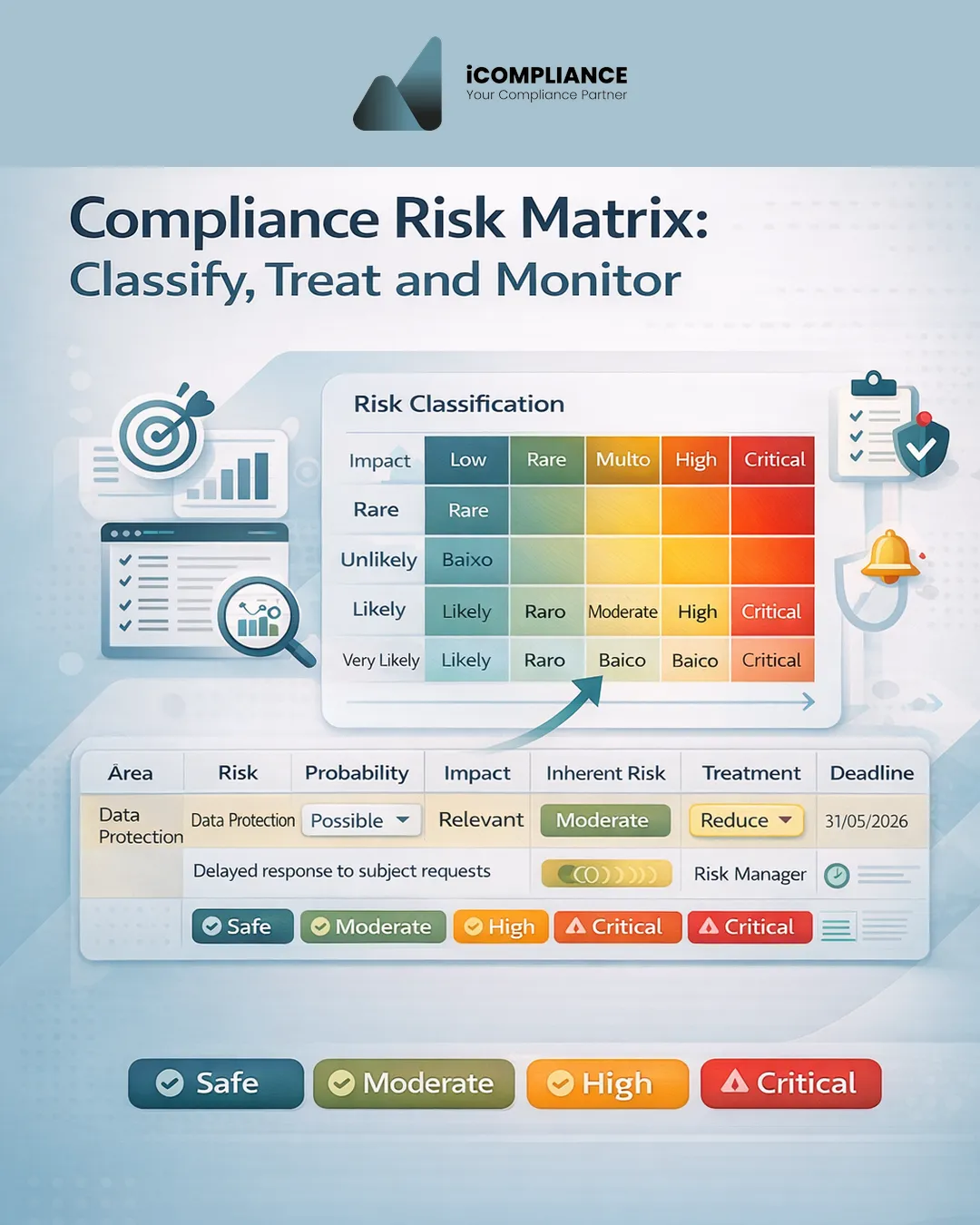
A compliance risk matrix is a framework that cross-references, in a simple and comparable way, two essential axes: probability and impact. Based on this combination, each risk is assigned a rating that helps define priority, urgency of action, escalation level and monitoring requirements.
In practice, the matrix answers very specific questions:
- What is the most critical compliance risk at this moment?
- Which risks can be accepted temporarily and which require immediate action?
- Where do we have weak or non-existent controls?
- Which areas require KRIs and enhanced monitoring?
- Where does it make sense to invest first: policies, training, controls, technology, audit or evidence?
A good matrix is not just for “scoring”. It is for governance. And to govern well, it needs to be linked to the organisation’s context, its risk appetite and the way teams make decisions.
Why so many matrices fail
The most common mistake is to create a generic matrix that is too theoretical and disconnected from real processes. Another frequent mistake is to list too many risks, without clear criteria, until the document becomes impossible to use. It is also common to confuse obligation with risk: the obligation is the requirement; the risk is the scenario of non-compliance and the associated consequence.
For example, “having a whistleblowing channel” is not, in itself, a risk. The risk could be: a breach of confidentiality in the channel, failure to respond within deadlines, unauthorised access, retaliation, lack of an auditable record, or failure to provide adequate feedback to the whistleblower.
A useful matrix must translate obligations into real operational scenarios. Only then does it become an actionable tool for compliance, audit and management.
How to structure a good compliance risk matrix
The first step is to define the risk universe. Rather than starting with hundreds of rows, it is preferable to organise risks by area. For example:
- anti-corruption and integrity
- data protection and privacy
- whistleblowing channels and investigations
- third-party due diligence
- conflicts of interest
- sanctions and export controls
- public procurement
- information security
- training and awareness
- document governance and retention
- evidence and traceability
- sector-specific obligations
Each area should then be translated into specific risk scenarios. The more operational the wording, the better. Instead of “GDPR non-compliance”, it is preferable to use something like: “late response to data subjects’ requests”, “lack of a documented legal basis”, “excessive data retention”, “transfers without adequate safeguards”.
Probability and impact: how to define consistent criteria
The matrix only works well if the scoring criteria are consistent. Otherwise, two different assessors will arrive at different results for the same risk.
A practical approach is to use a scale of 1 to 5 for probability and impact.
Probability
Probability measures the likelihood of the risk occurring, taking into account history, maturity of controls, volume of operations, reliance on third parties, regulatory complexity and frequency of activity.
A simple example:
- 1: rare
- 2: unlikely
- 3: possible
- 4: likely
- 5: very likely
Impact
Impact should reflect more than just the financial dimension. In compliance, the impact tends to be multidimensional. It may include:
- legal and regulatory impact
- reputational impact
- operational impact
- financial impact
- contractual impact
- impact on data subjects, whistleblowers, customers or employees
- impact on the ability to demonstrate due diligence in the face of an audit or supervision
Here too, it makes sense to use a scale of 1 to 5:
- 1: low
- 2: moderate
- 3: significant
- 4: high
- 5: critical
The key is to document the criteria. For example, what distinguishes a ‘high’ impact from a ‘critical’ impact? The answer must be set out in the methodology, and not depend on the perception at the time.
Inherent vs residual: a distinction that makes a difference
One of the signs of a mature framework is the separation between inherent risk and residual risk.
Inherent risk represents exposure before controls. Residual risk shows what remains after taking into account policies, training, approvals, validations, segregation of duties, technology, records and periodic review.
This distinction is important because it avoids two dangerous fallacies. The first is underestimating risks simply because ‘we already have a policy’. The second is overestimating controls that exist on paper but whose effectiveness has never been tested.
When the matrix shows a high inherent risk and a residual risk that is still high, the message is clear: the current controls are insufficient, are not mature, or are not being implemented consistently.
Risk appetite: where tolerance ends
Without risk appetite, the matrix loses its decision-making capacity. Everything seems urgent. Or, at the opposite extreme, everything is accepted.
Defining risk appetite in compliance means establishing which levels of exposure are tolerable, under what conditions and with what type of approval. Some organisations accept moderate risks with an action plan and a defined deadline. Others determine that risks linked to fraud, corruption, retaliation, confidentiality, sensitive data or repeated non-compliance have very low tolerance.
In practice, risk appetite must be linked to clear rules, such as:
- critical risks require immediate escalation
- high risks require a treatment plan with a designated person and a deadline
- moderate risks may be accepted temporarily with monitoring
- low risks remain under periodic observation
This is where the matrix becomes operationally useful. It ceases to be merely a map and becomes a governance tool.
How to address compliance risks
Once classified, a decision must be made. In compliance, there are four common responses.
The first is to avoid the risk by eliminating the activity, supplier, practice or process that creates the exposure.
The second is to reduce the risk by strengthening controls. This may involve reviewing policies, clarifying responsibilities, introducing approvals, improving records, testing controls, creating specific training, reviewing contracts or automating evidence.
The third is to share or transfer part of the exposure, for example through contractual clauses, insurance, controlled outsourcing or independent validations. In compliance, this option never removes the responsibility for oversight.
The fourth is to accept the risk, but only when the residual level is within the risk appetite and there is documented rationale.
A good matrix should have columns for:
- risk description
- associated obligation or reference
- process/area
- cause
- consequence
- existing controls
- inherent score
- residual score
- treatment decision
- responsible party
- deadline
- status
- associated evidence
- KRIs/KPIs
- review date
KRIs and KPIs: what to monitor to avoid managing ‘blindly’
A static matrix quickly becomes outdated. What keeps it alive are the indicators.
KRIs help to understand whether exposure is increasing. KPIs help to measure whether the control programme is working.
Useful examples by area:
Data protection
KRI: number of data subject requests received after the deadline
KPI: percentage of processing activities with a documented legal basis and retention period
Whistleblowing channel
KRI: cases without initial triage within the internal deadline
KPI: percentage of cases with complete and traceable records
Anti-corruption
KRI: gifts/hospitality outside policy or without approval
KPI: percentage of critical staff who have completed training
Third parties
KRI: critical suppliers without up-to-date due diligence
KPI: percentage of contracts with mandatory compliance clauses
Audit and control
KRI: recurrence of non-conformities in areas already audited
KPI: rate of closure of corrective actions within the deadline
The value of these indicators lies in their direct link to the matrix. It is not enough to report on attractive dashboards; the indicators must enable scores to be reviewed, risks to be reassessed and actions to be triggered.
Practical examples by area
To make the matrix more useful, it is worth including examples of risks by domain.
In data protection, common risks include excessive retention, lack of a documented legal basis, breaches of data subjects’ rights, unauthorised access and incomplete contracts with subcontractors.
In anti-corruption, undeclared conflicts of interest, payments without sufficient evidence, gifts and hospitality outside policy, opaque intermediation and insufficient due diligence frequently arise.
In whistleblowing channels, the most sensitive risks include breaches of confidentiality, delayed handling, excessive access, lack of functional segregation and poor preservation of evidence.
In third-party management, issues include contracts lacking minimum clauses, outdated assessments, incorrect criticality classification, a lack of continuous monitoring, and excessive reliance on suppliers with weak controls.
Every organisation will have its own profile, but the underlying logic is always the same: transforming abstract obligations into verifiable and manageable scenarios.
The role of technology and evidence
An Excel spreadsheet may suffice in the initial phase, provided the methodology is robust. But as the programme grows, the challenge shifts from filling in the spreadsheet to maintaining evidence, version control, accountability, deadlines, reviews and audit trails.
This is precisely where the services and solutions from iCompliance.eu can help. For organisations needing to implement or operationalise legal requirements and standards such as the GDPR, ISO 37301 and other frameworks, it makes sense to centralise risks, actions, responsible parties, documentation and evidence within a more controlled, auditable and scalable management model.
Mistakes to avoid
There are five mistakes that significantly reduce the value of the matrix.
The first is creating risks that are too vague.
The second is using arbitrary scores without a written methodology.
The third is failing to review the matrix following incidents, audits, legal changes or operational alterations.
The fourth is failing to link the matrix to action plans with responsible parties and deadlines.
The fifth is failing to measure the effectiveness of controls.
When these mistakes are made, the matrix ceases to be a management tool and becomes just another file.
Get the Compliance Risk Matrix Excel Template
Structure your matrix with fields for probability, impact, inherent risk, residual risk, treatment plan, KRIs, KPIs, responsible parties, deadlines and evidence.
Ideal for compliance, risk, internal audit, data protection and internal control teams looking to move from a reactive approach to a more consistent and auditable risk management process.
iCompliance.eu supports organisations in implementing compliance programmes, risk assessment methodologies, audit-ready evidence and the operationalisation of legal and regulatory requirements.
Conclusion
A well-constructed compliance risk matrix is not merely a requirement of good governance. It is a tool for making better decisions, justifying priorities, demonstrating due diligence and reducing actual exposure.
When the methodology is clear, the criteria are consistent and monitoring is linked to KRIs, KPIs, responsible parties and evidence, the organisation gains a much more mature view of its risk. Instead of reacting too late, it can anticipate, address and prove that it is managing the risk.
This is the point at which compliance ceases to be merely a documentary obligation and begins to function as a management capability.
Next steps
Download the Excel template for the compliance risk matrix and use it to map your organisation’s key risks. If you wish to structure the methodology, define classification criteria or align the matrix with the GDPR, ISO 37301 and other obligations, iCompliance.eu can support the implementation.
🔗 Suggested reading
- Governance, methodology and compliance programmes: ISO 37301 – Compliance management systems
- Risk matrix, risk appetite, governance: COSO Enterprise Risk Management
- Whistleblowing channels and GDPR: iBlow Europe
- Anti-corruption risks, whistleblowing channels, internal controls: National Anti-Corruption Mechanism (MENAC)
- Ethics, third parties, anti-corruption, governance: OECD Integrity
- Other articles: iCompliance Europe Resources