
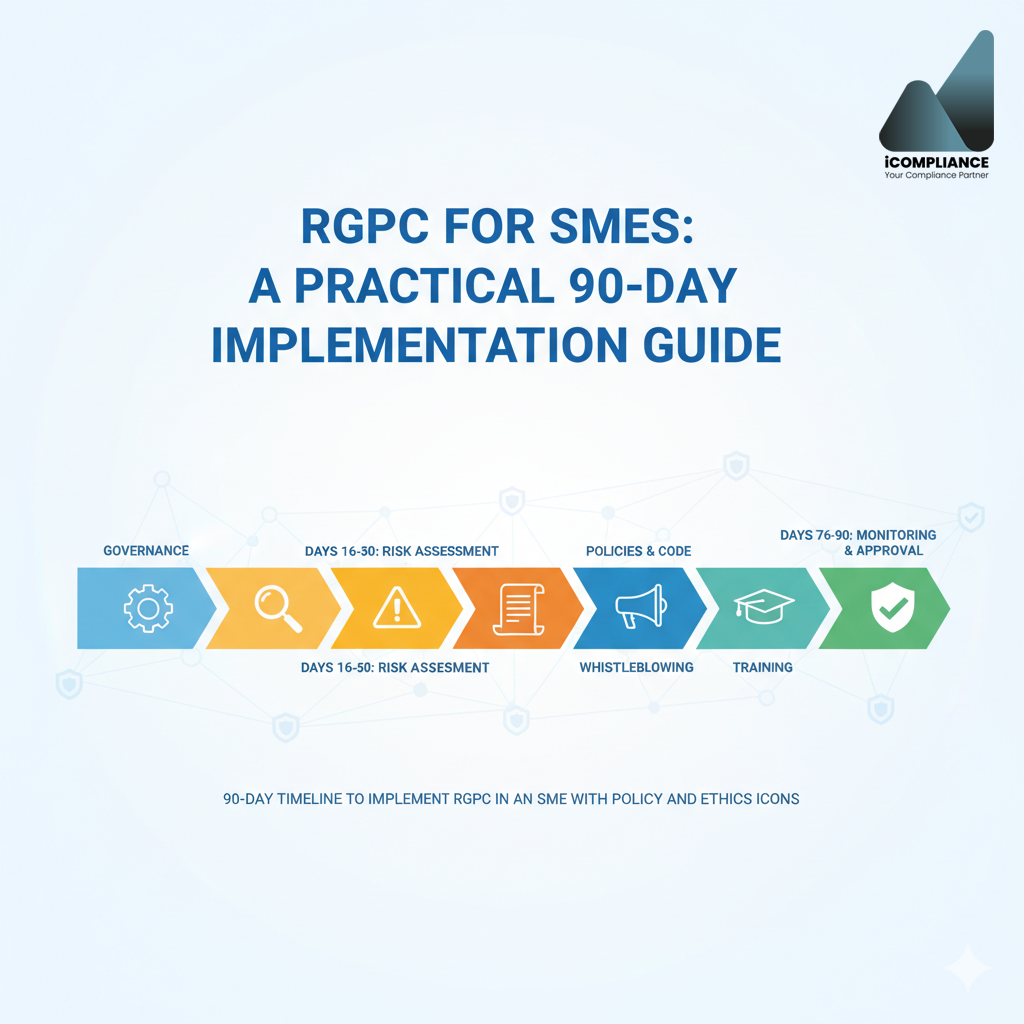
A step-by-step plan to make a small or mid-sized company compliant with the Portuguese Anti-Corruption Compliance Programme (RGPC) in 90 days, including responsibilities, practical examples, and a ready-to-use checklist.
Why act now?
- Avoid fines and reputational harm: non-compliance risks sanctions and loss of trust.
- Professionalise management: clear controls, policies and training reduce legal and operational exposure.
- Competitive edge: large clients and public sector tenders increasingly expect demonstrable integrity practices.
Core RGPC elements for SMEs
- Governance & leadership – appoint a Compliance Officer and secure leadership buy-in.
- Risk assessment – map exposure across processes (procurement, contracting, gifts/hospitality, sponsorships, third parties, hiring).
- Policies & procedures – code of conduct; conflicts of interest; gifts & hospitality; third-party due diligence; sponsorships/donations.
- Whistleblowing channel – secure, confidential/anonymous, with routing and deadlines.
- Training & communication – tailor by role and risk.
- Monitoring & improvement – KPIs, audits, periodic reporting to management.
The 90-day plan (week by week)
Days 1–15: Kick-off and programme governance
- Executive sponsorship: formal decision to implement RGPC.
- Appoint Compliance Officer (CO): mandate, autonomy, reporting line.
- Project plan & timeline: weekly milestones, responsibilities (RACI), project risks.
- Document inventory: existing policies, org chart, template contracts, core process maps.
Deliverables:
- Board/management resolution and CO appointment note.
- Project plan & Gantt/timeline.
- Stakeholder map (Finance, Procurement, HR, Sales, Legal/IT).
Days 16–30: Integrity risk assessment
- Risk workshops by process: procurement, public/private contracting, sales, logistics, sponsorships, marketing, HR.
- Identify risk events: fraud, favouritism, conflicts of interest, bribery, facilitation payments, misuse of assets.
- Score & prioritise: likelihood × impact; evaluate current controls and gaps.
- Risk map & treatment plan: prioritise 5–10 critical risks; define controls (policy, approvals, segregation of duties, logs).
Deliverables:
- Risk matrix (owners, controls, priorities).
- Treatment plan (actions, deadlines, owners).
Days 31–45: Essential policies and procedures
- Code of Conduct: principles, practical scenarios, Q&A contact.
- Conflicts of Interest: annual and ad hoc declarations; approval/mitigation flow.
- Gifts & Hospitality: thresholds, mandatory register, approvals.
- Third parties & suppliers: risk-based due diligence; integrity clauses.
- Sponsorships/Donations: criteria, transparency, record-keeping.
- Records & evidence: simple templates (Excel/SharePoint) for gifts, conflicts, due diligence.
Deliverables:
- Policy pack v1.0 submitted to management.
- Registers (gifts/hospitality; conflicts; third-party DD).
- Standard contract clauses.
Days 46–60: Whistleblowing channel and response
- Select the channel solution: internal/external; confidentiality, anonymity, audit trail, SLA.
- Whistleblowing & anti-retaliation policy: scope, how to report, protections, feedback timelines.
- Triage & investigation procedure: severity criteria, investigation team, chain of custody, reporting template.
- End-to-end test: submission, acknowledgement, investigation, closure with feedback.
Deliverables:
- Live, tested whistleblowing channel.
- Investigation procedure + templates (NDA, investigation plan, report).
Days 61–75: Training and awareness
- Role-based plan: executives (tone from the top); risk-exposed areas (Procurement/Sales/HR); all-hands; onboarding.
- Materials: slide deck, short video, FAQs, intranet posters/banners.
- Internal campaign: CEO email, QR code to channel, “do & don’t” examples.
- Tracking & evaluation: sign-in or LMS; short quiz; target ≥90% coverage.
Deliverables:
- Awareness kit and training pathway.
- Coverage report & quiz results.
Days 76–90: Monitoring, KPIs and final approval
- Baseline KPIs: number of reports/resolved; average response time; % trained; conflicts declared/resolved; % third parties with DD; number of approved exceptions.
- Monitoring plan: quarterly reviews, light annual audit, effectiveness testing.
- Final management report: compliance status, remaining gaps, 6–12-month improvement plan.
- Approval & publication: policies approved; external notice on website; embed in onboarding.
Deliverables:
- Compliance dashboard (monthly/quarterly).
- Final implementation report and improvement roadmap.
SME-friendly good practices
- Proportionality: keep policies lean, unambiguous; scale DD to risk.
- Reuse what exists: integrate with quality/H&S controls where sensible.
- Evidence culture: “if it isn’t recorded, it didn’t happen.”
- Lightweight tech: online forms, central repository, automated reminders (e.g., annual conflict declarations).
RGPC Checklist for SMEs (grab & use)
Governance
- Formal management decision and CO appointment.
- 90-day plan with milestones.
Risk
- Risk workshops and matrix by core process.
- Treatment plan with owners and deadlines.
Policies
- Code of Conduct approved and published.
- Policies: Conflicts of Interest; Gifts & Hospitality; Third Parties; Sponsorships/Donations.
- Integrity clauses inserted in contracts.
- Registers active (gifts; conflicts; DD).
Whistleblowing
- Channel live (confidential/anonymous), policy and investigation procedure.
- Documented end-to-end test.
Training & Comms
- Role-based plan, materials, and attendance evidence.
- Internal campaign and FAQs.
Monitoring
- KPIs defined and dashboard set.
- Final report and 6–12-month plan.
Download the SME RGPC checklist to fast-track your 12-week rollout.