
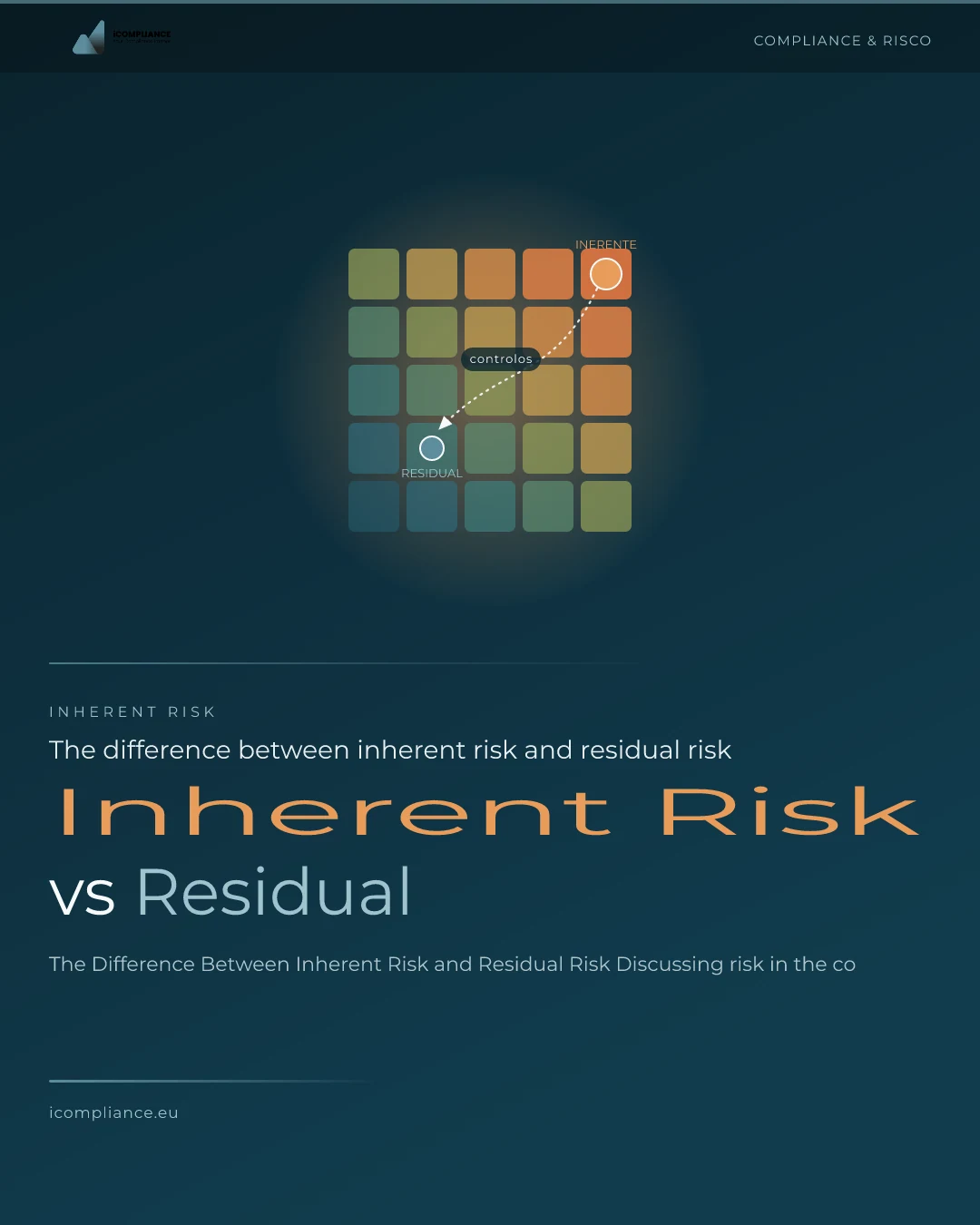
The Difference Between Inherent Risk and Residual Risk
Discussing risk in compliance without properly distinguishing between inherent risk and residual risk is one of the quickest ways to produce unreliable assessments, misplaced priorities and reports that look sound on paper but fail when it comes to making decisions. This distinction is not merely technical. It influences the way an organisation designs controls, allocates resources, accepts exposures and demonstrates maturity to auditors, supervisors, partners and management bodies. Broadly speaking, market and risk management references treat inherent risk as the risk that exists prior to specific management actions to reduce it, and residual risk as the risk that remains after the implementation of such responses, controls or mitigation measures.
This distinction is particularly relevant because the frameworks most commonly used in business practice treat risk management as part of governance, strategy and performance. ISO 31000 sets out principles, a framework and a process for managing risk in any organisation, across any sector, and emphasises that its application helps to improve the identification of opportunities and threats and to support more consistent decision-making. COSO ERM, on the other hand, frames risk within the link between strategy, objectives and performance, and has even published specific guidance on compliance risk management.
What is inherent risk
In practice, inherent risk answers questions such as these: if this process were to fail, what would be the potential impact? If there were no relevant controls in place, how likely would it be to occur? What exposure would there be in areas such as anti-corruption, data protection, sanctions, public procurement, conflicts of interest, critical outsourcing or information security? The aim here is not to dramatise the risk, but to understand the intrinsic nature of the exposure. Activities involving large sums of money, high commercial pressure, low transparency, the processing of sensitive data, reliance on third parties or high regulatory scrutiny tend to present a higher inherent risk.
What is residual risk?
Residual risk is the risk that remains after an organisation has implemented controls, risk responses, procedures, monitoring mechanisms or other risk treatment measures. In various NIST references, residual risk is described as the portion of risk that remains after security measures, controls or risk responses have been implemented. ISO’s own terminology relating to risk refers to the risk remaining after risk treatment.
Here is a key point: residual risk does not mean eliminated risk. On the contrary, reference frameworks emphasise that, regardless of the response adopted, some degree of residual risk usually remains. What the organisation needs to decide is whether this residual risk is acceptable, tolerable with monitoring, or still excessive, requiring further mitigation. NIST SP 800-37 expressly states that, regardless of the response to risk, a degree of residual risk remains, and that the acceptable level depends on the organisation’s risk tolerance.
The difference, in simple terms
The simplest way to explain the difference is as follows:
Inherent risk: the risk of the activity ‘as it is’, before considering specific controls.
Residual risk: the risk that remains after we have assessed the controls that actually exist and are working.
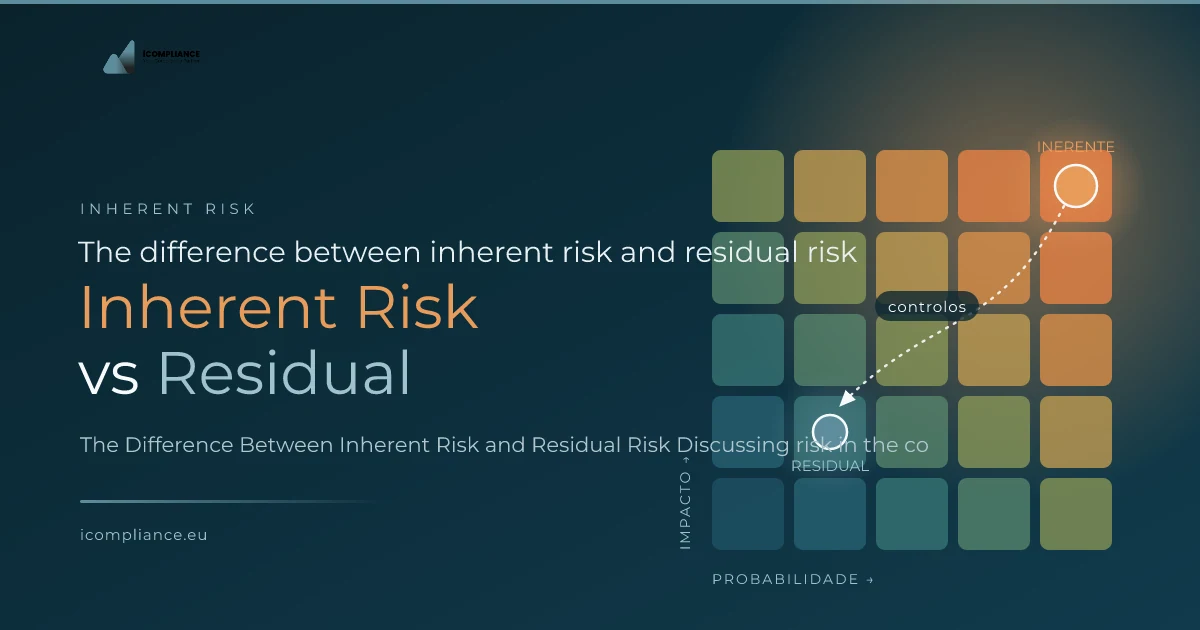
Therefore, inherent risk helps us understand where the exposure originates, whilst residual risk helps us understand where the exposure remains after management has taken action. This distinction completely changes the conclusions. Two areas may have high inherent risk, but one may have moderate residual risk because the controls are robust, whilst the other may still have high residual risk because the controls are weak, informal, incomplete or poorly implemented.
Practical example
Imagine a supplier procurement process within an organisation with international operations, recurring payments and decentralised teams.
The inherent risk may be high for several reasons: the possibility of conflicts of interest, undue favouritism, incomplete documentation, payments to third parties without sufficient validation, pressure to act quickly, and reputational exposure. Even before looking at the controls, there is already a strong combination of impact and probability.
Now let us assess the existing controls: supplier due diligence, segregation of duties, two-level approval, declaration of conflicts of interest, contractual clauses, financial review, audit trail and monitoring of exceptions.
If these controls are formalised, used consistently, supported by evidence, have a defined owner and are reviewed periodically, the residual risk may fall to medium or even medium-low. But if some of the controls exist only ‘in theory’, if there is no documentary evidence, if exceptions are frequent, or if the approvers are always the same without independent review, the residual risk will remain high. The point is not the list of controls on paper; it is their actual effectiveness. This interpretation is in line with the logic of risk assessment and response processes adopted by NIST and ISO 31000.
The most common mistake
A very common mistake is to treat residual risk as an automatic subtraction from inherent risk. For example: “the inherent risk was 5, we applied two controls, so it has now dropped to 2”. This may be useful as a pedagogical simplification in some matrices, but it should not be confused with a universal technical truth.
In practice, residual risk results from a reassessment of exposure following an analysis of the quality of the controls. This analysis must consider, at a minimum, the control’s design, actual implementation, frequency, coverage, evidence, automation, segregation, independence, detection capability, response time and continuous monitoring. If the control exists but does not work, the residual risk may remain very close to the inherent risk.
Why this distinction is critical in compliance
In compliance, confusing inherent risk with residual risk usually leads to three problems.
The first is a false sense of security. The organisation identifies various controls, concludes that the risk is ‘already addressed’, but never tests whether those controls actually work.
The second is poor prioritisation. Areas with high inherent risk may warrant a great deal of initial attention, but what should drive prioritisation, action plans and executive reporting is often the residual risk — particularly when this exceeds the defined risk appetite or tolerance.
The third is distorted reporting. A risk map that conflates concepts ultimately fails to answer the question that management really wants clarified: “Having done what we’ve done, where are we still most exposed?”
This is why current guidance on ERM and risk appetite links risk management to decision-making and the organisation’s objectives. COSO specifically highlights the importance of linking risk appetite to strategy and objectives, whilst NIST distinguis
hes between current residual risk and the target residual risk that the organisation intends to assume.
Residual risk and risk appetite are not the same thing
Another common misconception is to confuse residual risk with risk appetite.
Residual risk is the risk remaining after controls have been applied.
Risk appetite is the level of risk that the organisation is willing to accept in pursuit of its objectives.
They are related but distinct concepts. The correct comparison is as follows: after calculating or assessing residual risk, the organisation must check whether it falls within or outside the defined risk appetite and tolerance. COSO emphasises that risk appetite must be linked to strategy and objectives and form an integral part of decision-making. NIST also states that the actual residual risk should ideally be equal to or less than the target residual risk.
How to correctly assess inherent and residual risk
A robust yet practical approach can follow these steps:
Start by defining the subject of analysis: a process, regulatory obligation, unit, supplier, system, critical activity or risk scenario.
Then assess the inherent risk, looking at impact and probability without considering specific controls. Here, it is important to analyse factors such as complexity, volume, sensitivity, external exposure, reliance on key personnel, geographical dispersion, third parties, incident history and regulatory changes.
Next, identify the existing controls and assess their actual effectiveness. It is not enough simply to know whether policies exist. You need to understand whether there is implementation, evidence, designated responsible parties, frequency, testing and indicators.
Only then can the residual risk be assessed – that is, the exposure that actually remains.
Finally, compare the residual risk with the risk appetite, prioritise additional actions and assign owners, deadlines and monitoring metrics. This approach is in line with recognised risk management processes and with the idea that risk should be treated as an element of governance and performance, not merely as a documentary checklist.
Link to the RGPC and compliance programmes in Portugal
In Portugal, this distinction is particularly useful for organisations covered by the RGPC. Decree-Law No. 109-E/2021 establishes the general framework for the prevention of corruption and requires the adoption of compliance programmes, including risk prevention or management plans, codes of conduct, training programmes, whistleblowing channels and a compliance officer. The legislation generally applies to legal persons and public bodies with 50 or more employees.
However, a serious risk prevention plan should not merely list areas of exposure. It must identify the risks inherent in the activity, set out the controls in place, assess their effectiveness, and determine the residual exposure. It is precisely here that the distinction between inherent risk and residual risk makes the difference between a formalistic document and a genuinely useful tool for management, prevention and demonstrating due diligence.
What your risk map should include
If you want the risk map to be useful for compliance, auditing, management and internal oversight, each risk should include, at a minimum:
- a clear description of the risk scenario;
- the associated category or obligation;
- the assessment of inherent risk;
- the existing controls;
- an assessment of the effectiveness of the controls;
- the assessment of residual risk;
- the applicable risk appetite or tolerance;
- the action plan, owner and deadline.
This ensures that the risk register is not merely a static table. It becomes a decision-making tool.
Frequently Asked Questions
Do you want to improve the way your organisation assesses risk?
iCompliance.eu supports organisations in structuring risk matrices, compliance programmes, the implementation of GDPR requirements, internal control and more consistent, practical and auditable assessment methodologies.
If you wish to review how you assess inherent risk, the effectiveness of controls and residual risk, it is worth starting with a structured assessment.
Conclusion
The difference between inherent risk and residual risk seems simple, but it has a direct impact on the quality of the compliance programme.
Inherent risk shows the original exposure of the activity.
Residual risk shows what actually continues to threaten the organisation after controls have been applied.
When an organisation clearly distinguishes between these two concepts, it gains the clarity to decide where to invest, what to strengthen, which risks to accept and how to justify that acceptance. When it confuses the two, it risks creating a false narrative of control.
In practical terms, the right question is not simply ‘what is the risk?’. The right question is: what was the risk before the controls were put in place, what is the risk after they have been implemented, and is that level still acceptable to the organisation?
For compliance, risk, internal audit and management teams, this is a distinction that improves the quality of matrices, reporting to senior management and action plans. And for organisations that are structuring or reviewing their compliance programme, internal control framework or GDPR implementation, it provides an essential foundation for a system that is more defensible, more useful and better aligned with international best practice.
Frequently Asked Questions
What is inherent risk?
It is the level of risk that exists before any control or mitigation measure is applied.
What is residual risk?
It is the risk that remains after controls and mitigation measures have been applied.
How is residual risk calculated?
The impact and probability of the risk are assessed after the controls are in place, using a 5×5 risk matrix or similar.
What is the difference between inherent risk and residual risk in compliance?
In compliance, inherent risk is the exposure prior to policies and controls. Residual risk is what remains after the compliance programme has been implemented, including training, auditing and the whistleblowing channel.
Why is it important to monitor residual risk?
Residual risk is not static: as the context changes, controls may become insufficient. Continuous monitoring ensures that residual risk remains within the risk appetite defined by the organisation.