
Book
Risk diagnostic: request an assessment to evaluate the maturity of your risk management, your risk appetite, your KRIs/KPIs, your controls and the reports submitted to senior management.
Response within 1 working day · No obligation
Risk management
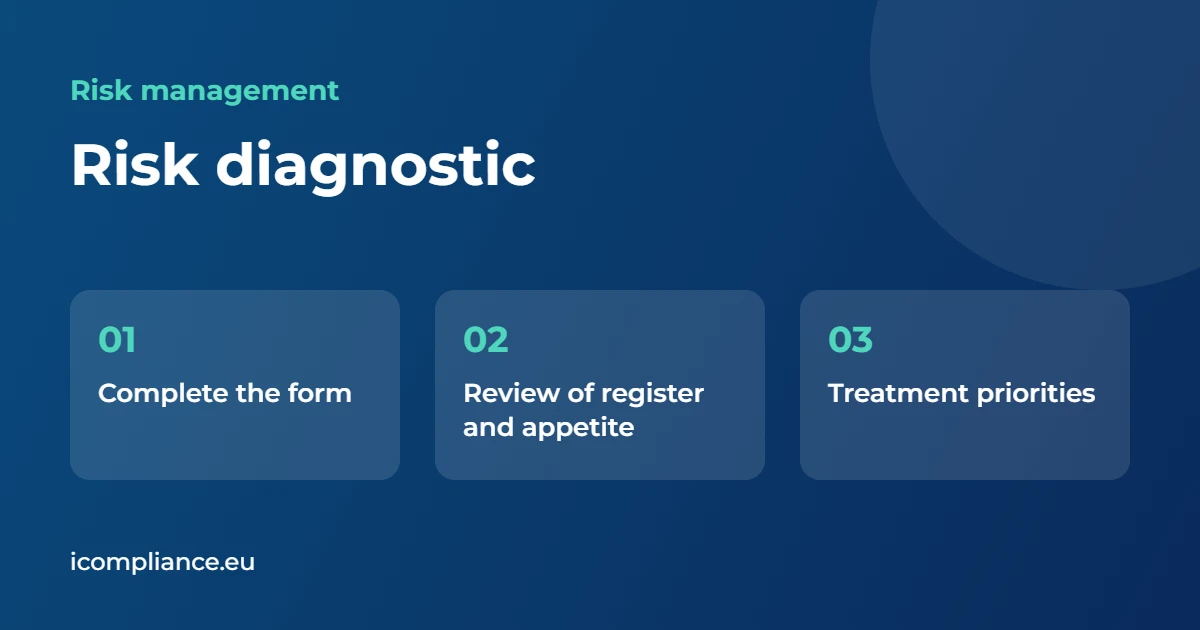
A risk diagnostic is the starting point for risk management that genuinely supports board-level decisions. Instead of long, outdated lists, iCompliance helps you identify the risks most likely to affect your business objectives, assess their likelihood and impact, and set realistic treatment priorities.
Based on the information you provide in the form, we look at your sector of activity, the main risks you identify, whether a risk register exists and whether a risk appetite has been defined, as well as the goal you want to achieve with the diagnostic. These elements show whether your organisation starts from a structured base or needs to build the foundations from scratch.
The result is an objective view of the current situation: which risks are covered, which lack an owner and controls, and where information is insufficient to decide. From there, the team recommends priorities, suggested owners and next steps.
It is particularly useful when the company has no formal risk register, when risk appetite has never been defined, before an audit, a certification process or a significant transaction, and whenever management needs a clear basis to decide where to invest in controls.
You receive a summary of the main risks by category (strategic, operational, financial, compliance and reputational), a preliminary assessment of likelihood and impact, the gaps identified in the risk register and risk appetite, and a proposal of treatment priorities with suggested owners. This result is a basis for management decisions, the internal audit plan and certification preparation.
Risk management does not live in isolation: it feeds the compliance programme, data protection, ESG reporting and supplier management. The diagnostic therefore also identifies where existing controls already address the main risks and where there are overlaps or gaps, to avoid duplicated effort.
Risk management can rely on recognised frameworks such as ISO 31000, which sets out principles and guidelines for managing risk consistently. Learn more about our CCOaaS service and our ESG maturity assessment.
Do I need a risk register to request the diagnostic? No. If you do not have one yet, the diagnostic helps you understand where to start.
Is the diagnostic suitable for SMEs? Yes. The approach is adjusted to the size and sector of the organisation, without unnecessary bureaucracy.
What happens after I send the form? Our team reviews the information and gets in touch to agree the next steps. You can also talk to our team.