
VSME · Voluntary Sustainability Report
Not falling within the mandatory scope of the CSRD does not mean you no longer need to report on ESG. The VSME is the voluntary standard designed by the European Commission specifically for SMEs that need to provide information to banks, investors and customers, without the level of rigour required by the CSRD.
The narrowing of the CSRD’s mandatory scope, under Directive (EU) 2026/470, has removed many SMEs from the legal obligation to report. However, the demand for ESG information has not disappeared: banks assess credit risk using ESG criteria, investors request it as part of their due diligence, and large companies subject to the CSRD need data from their suppliers to comply with their own value chain reporting requirements. Without a standardised format, SMEs would end up responding to ad hoc questionnaires, which differed for each client or bank.
The VSME (Voluntary Sustainability Reporting Standard for SMEs) is a voluntary standard, adopted by the European Commission by means of a delegated act in 2026, designed specifically for SMEs — with requirements proportionate to their size and resources, in contrast to the comprehensive ESRS under the CSRD. It is structured into two modules:
Basic Module — an essential set of environmental, social and governance indicators, designed as a minimal, structured response to requests from third parties.
Comprehensive Module — provides more detailed disclosures, relevant to SMEs that form part of the value chain of a company subject to the CSRD and need to provide more granular data.
SMEs that already receive regular ESG requests from banks or investors; suppliers to large companies subject to the CSRD; and any SME wishing to credibly demonstrate its ESG performance to customers and partners, without having to set up a reporting process that is disproportionate to its size.
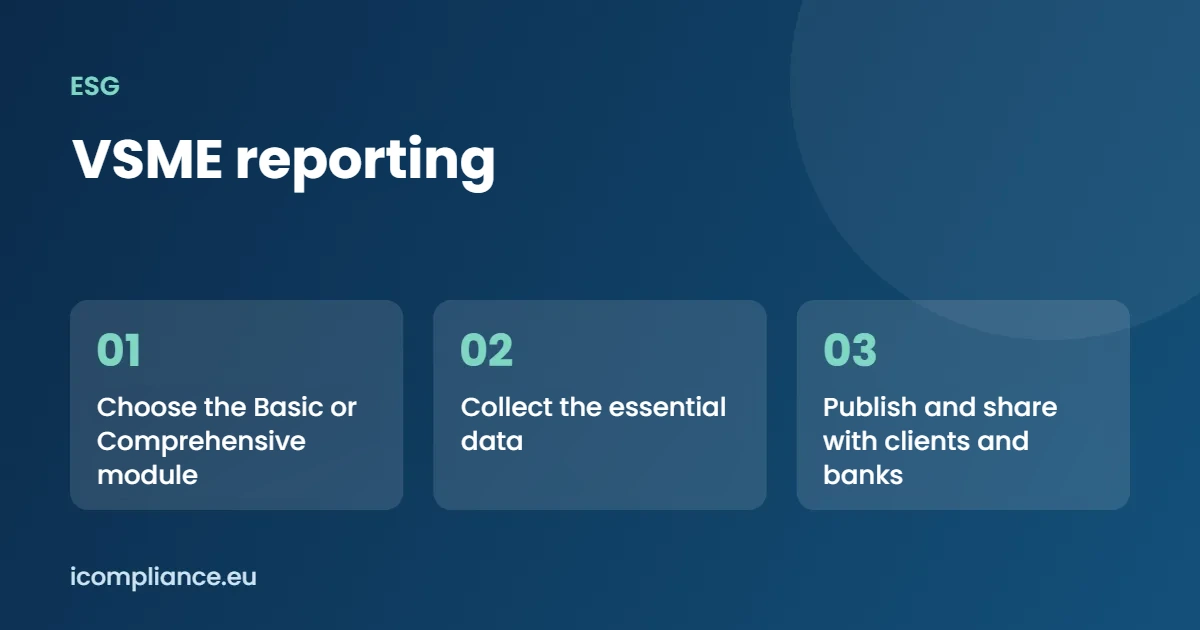
The typical process begins by identifying who is requesting ESG information from the company (and how often), choosing between the Basic and Comprehensive modules based on these requests, mapping the data already available internally, and filling in the gaps using a simple, repeatable data collection process — so that one year’s report can serve as the basis for the next, rather than starting from scratch.
Frequently Asked Questions
Sustainability reporting
VSME explained in plain terms: the VSME is a voluntary sustainability reporting standard developed by EFRAG for small and medium-sized enterprises that are not required to report under the CSRD. It gives SMEs a proportionate way to collect and share sustainability information with the customers, banks and investors that increasingly ask for it.
SMEs that receive ESG questionnaires from larger customers, that apply for financing or that want a structured starting point for sustainability reporting. Using one recognised format avoids answering each request in a different way and helps you build a reliable data foundation.
The standard has a Basic Module and a Comprehensive Module. The Basic Module covers general information about the business and core environmental, social and governance datapoints, while the Comprehensive Module adds strategy, business model and policy information for companies that want to go further. You can start with the Basic Module and expand later.
Define the reporting scope, identify who owns each datapoint, collect the data for a full financial year and document your assumptions. A short readiness assessment shows which datapoints you already have and which need new processes.
Sources and next steps: the standard is published by EFRAG. Read our guide to VSME reporting for SMEs or book an ESG assessment.