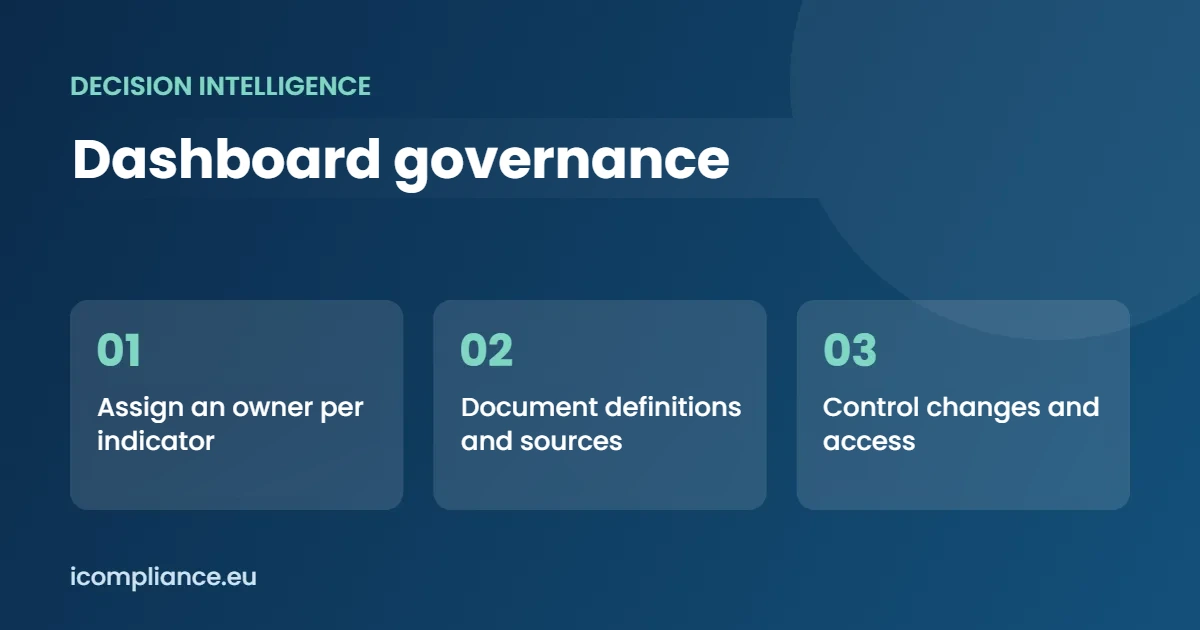
Dashboard governance defines who is responsible for each indicator, how it is calculated, where the data comes from and who can change the dashboard. Without these rules, the numbers start to diverge between areas and the board loses confidence in the information.
Essential elements
An indicator dictionary with definition, formula, source and update frequency, an owner for each indicator, data quality controls, a process to request and approve changes, and access rules proportionate to the sensitivity of the information.
How to keep the dashboard useful over time
The dashboard should be reviewed in fixed cycles, indicators that are not used should be retired, changes made should be recorded and the time it takes to update should be measured. A simple audit that compares the dashboard numbers with the original source detects deviations before they reach the board.
The principle that management information must be reliable and communicated appropriately is present in the ISO 31000 standard and in COSO ERM guidance.
iCompliance support
iCompliance helps organisations implement dashboard governance, with an indicator dictionary, owners, data quality controls and a change process. The work includes documentation and training of the owners. To understand where to start, talk to our team and receive a proposal tailored to the size and sector of your organisation.
A board dashboard is only as reliable as the governance behind it. Without clear ownership and rules, indicators drift, definitions change quietly and the numbers shown in one meeting no longer match the next. Good governance prevents this with a small set of agreed principles.
First, every indicator needs a definition: what it measures, the formula, the data source, the frequency and the person accountable. Second, there must be a controlled process to collect, validate and approve the data before it reaches the board, including who reviews exceptions. Third, changes to indicators, thresholds or sources should be recorded, so that comparisons across periods remain meaningful.
We also recommend limiting the dashboard to the information the board actually uses to decide. A page or two of priority indicators on risk, performance and compliance is usually more effective than dozens of charts. Each indicator can link to a more detailed view for management, but the board sees only what supports its role.
A practical structure combines four blocks: strategic risks and their trend, financial and operational performance, compliance and audit findings, and sustainability or ESG indicators where relevant. Thresholds and colour rules should be defined in advance, with clear escalation steps when a limit is crossed.
Finally, the dashboard needs a review cycle. At least once a year the board should confirm that indicators still reflect the business, retire those no longer useful and add the ones the new context requires. This routine keeps the dashboard credible and avoids the common situation in which a good initial design slowly loses relevance.
We help organisations define these rules, build the first version and document the process so that it can run with internal resources.