
Board Oversight
A structured reporting system that enables management to exercise effective oversight of performance and risk.
We have designed the information package that enables management to exercise effective oversight — not merely to receive reports, but to ask questions and make decisions based on them.
A framework for regular reporting to management, with performance and risk indicators aligned with the body’s supervisory responsibilities.
Management meetings that focus more on strategic decision-making, with less time spent verifying figures.
A 30-minute conversation to assess priorities and draw up a practical plan — together.
Governance
Board oversight is the supervision that the board of directors exercises over the strategy, risk, performance and compliance of the organisation. It is effective when the board receives relevant information, asks informed questions and follows decisions through to execution.
Clear roles and responsibilities between the board, committees and management, an annual agenda covering strategy, risk, compliance and sustainability, concise and timely information, and channels to escalate relevant matters without passing through filters that dilute them.
Meetings dominated by long presentations, information that arrives on the same day, decisions without a record, risks that only appear after they have materialised, and new matters, such as sustainability and digital resilience, with no identified owner on the board.
The ISO 37000 standard on the governance of organisations describes principles of good governance, and COSO ERM explains how to integrate risk into strategy and performance.
iCompliance helps organisations strengthen board oversight, with a responsibilities map, an annual board agenda, information packs and an assessment of the effectiveness of oversight. The work includes working sessions with directors and committees. To understand where to start, talk to our team and receive a proposal tailored to the size and sector of your organisation.
Effective board oversight depends on receiving the right information at the right time. Many boards are given either too little detail to challenge management or so much that key messages are lost. A structured reporting system helps directors focus on strategy, performance, risk and compliance without becoming involved in daily operations.
We help organisations define what the board needs to see, how often and in what format. A typical package includes a short set of performance indicators, a summary of the main risks with their trend and treatment status, compliance and audit findings, and, where relevant, sustainability indicators. Each item has an owner and a clear explanation, so the discussion in the meeting centres on decisions.
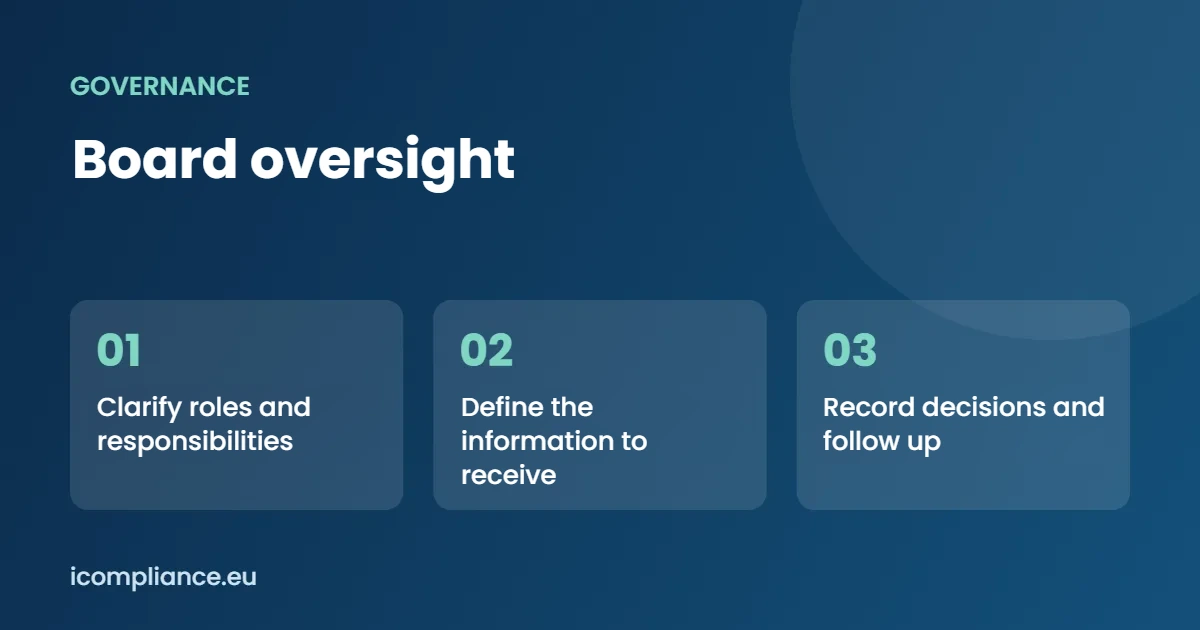
Several principles make oversight more effective. Roles must be clear: the board sets direction and supervises, while management executes and reports. Information must be reliable, with defined sources, validation and approval before it reaches the board. Risk appetite and thresholds should be agreed in advance, so everyone knows when an issue requires escalation. And follow-up must be systematic: decisions and actions from each meeting are recorded and reviewed at the next one.
Aligning with ISO 31000 helps ensure that risk is considered as part of strategy and performance, not a separate topic. In the same way, integrating ESG matters into the regular agenda prepares the board for the expectations of regulators, banks and investors.
Improving board oversight does not require a large project. We usually start by reviewing the information the board currently receives, interviewing a few members and management, and identifying what is missing or redundant. From there we propose a leaner reporting format, test it in one or two meetings and refine it.
Over time, the same structure can support internal audit, annual reports and discussions with financing partners. If your board would benefit from clearer and more useful information, we can propose a model adapted to your size, sector and governance structure.
Frequently Asked Questions
Board Oversight refers to the structure of the information package and the frequency of reporting that enables the board to exercise effective oversight, based on performance and risk rather than operational detail.
We work in stages: initial assessment, setting priorities, practical implementation and ongoing monitoring with clear indicators of progress.
Timeframes vary depending on the size and maturity of the organisation, but the initial assessment usually takes 2 to 4 weeks before we move on to implementation.
Let’s assess your priorities and draw up a practical plan — together.