
ESG — Use case
A structured response to ESG questionnaires and enquiries from clients, suppliers, banks, investors and regulatory bodies.

The company receives ESG requests with tight deadlines, scattered data and varying terminology across clients.

We have created a reusable database of responses, evidence, owners and indicators.

Less effort per order and greater consistency in external communications.
A 30-minute conversation to assess priorities and draw up a practical plan — together.
ESG
ESG stakeholder requests arrive in the form of customer questionnaires, bank assessments, investor requests and tender requirements. Without preparation, each request consumes time, produces different answers to the same question and exposes the organisation to inconsistencies.
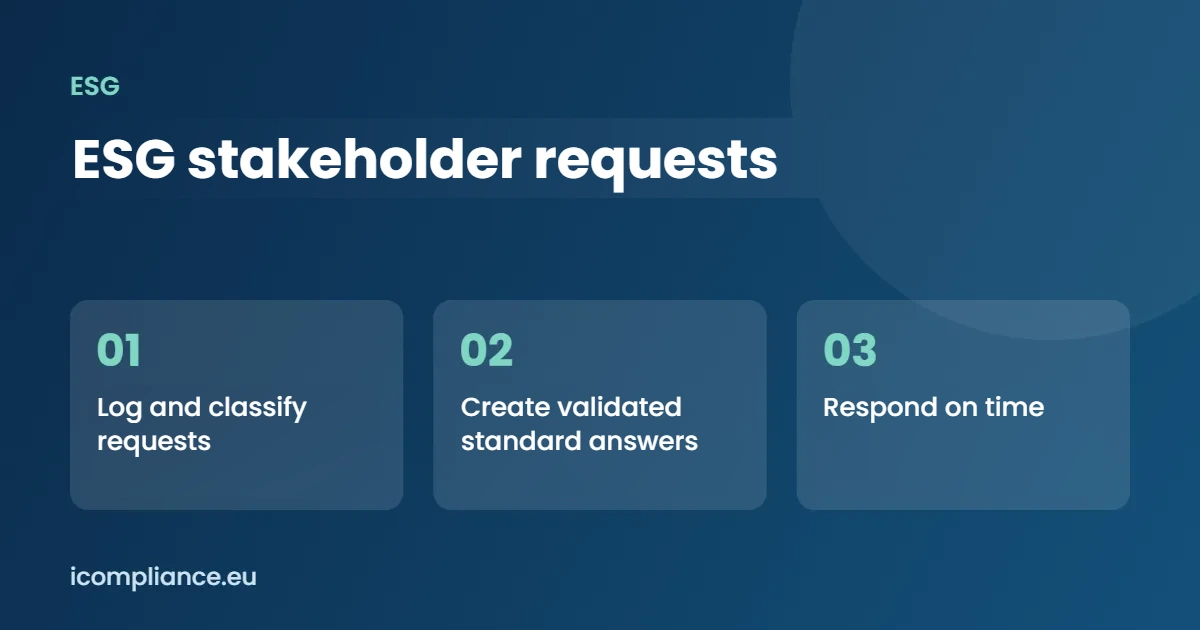
It starts by recording all requests, classifying them by topic and deadline, and identifying who in the organisation holds the information. Then a base of validated answers is built, with data, policies and evidence, which is updated periodically and reused in every new request.
It reduces the effort per request, improves the quality and consistency of answers, detects gaps that should be corrected and shows stakeholders that the organisation manages the topic seriously. It is advisable to have a person responsible for coordination and rules on what can be disclosed and by whom.
Many requests refer to frameworks such as the EFRAG ESRS, the GRI standards or the VSME, so aligning the answer base with one of them simplifies the work.
Should we answer every questionnaire? It is advisable to assess the relevance of each request, the deadline and the effort. A base of validated answers makes responding quick, but sensitive information must always be approved by a person in charge before it leaves the organisation.
How can we avoid contradictory answers? By centralising answers in a single base, with version, date and approval, and appointing one person to coordinate. That way, the same question always gets the same answer, regardless of who receives it.
iCompliance helps organisations prepare for ESG stakeholder requests, with the recording and classification of requests, the base of validated answers and the coordination and approval process. To find out where to start, talk to our team and receive a proposal tailored to the size and sector of your organisation.
More and more organisations receive requests from ESG stakeholders: customers sending sustainability questionnaires, banks asking for data to assess financing, investors seeking climate information and public buyers requiring evidence in tenders. Each request looks slightly different, which creates a heavy workload and a risk of inconsistent answers.
Our approach is to build a single, reliable base of information from which every answer can be drawn. We start by collecting the questionnaires you have received and identifying the topics that repeat: emissions, energy, workforce, health and safety, ethics, supply chain and policies. Then we create a central set of approved answers, with supporting documents and clear owners, so that replying to a new request becomes a matter of selection and review rather than starting again.
A good process has four steps. First, register each request with its origin, deadline and the person responsible. Second, check which parts can be answered with existing approved content and which need new data. Third, review the answer internally, ideally with someone from management, before it is sent. Fourth, archive the response and the evidence, so that later requests can reuse it and so that you can show consistency over time.
This structure also protects you from commitments that cannot be fulfilled. Answers should reflect what the organisation actually does, with evidence, and should state clearly where measurement is still being developed. Credible honesty is usually better received than optimistic statements that cannot be verified.
Where possible, we map the requests to recognised frameworks. Large customers in scope of the CSRD may ask their suppliers for data that feeds their own reporting. Smaller suppliers can use the VSME standard as a common language, which reduces the number of different questionnaires to answer. Banks increasingly ask for ESG information as part of credit assessment, and having a consistent dataset speeds up those conversations.
We can also help define who in the organisation speaks on ESG topics, what can be shared publicly and what requires confidentiality. A simple internal policy avoids contradictory statements and keeps communication aligned with your strategy.
If you are overwhelmed by questionnaires, we can review the last requests you received, identify what to standardise and set up a response pack that saves time in every future cycle.
A response pack also helps new team members. Instead of searching old emails, they find approved texts, evidence and contacts in one place. Over time, you can see which questions appear most often and decide which policies or measurements deserve investment first, based on real requests.

Let’s assess your priorities and draw up a practical plan — together.