
ESG
Voluntary ESG reporting is the disclosure of sustainability information that an organisation makes without a direct legal obligation, to respond to customers, banks, investors, employees and other stakeholders. When well prepared, it avoids improvised answers to every questionnaire.
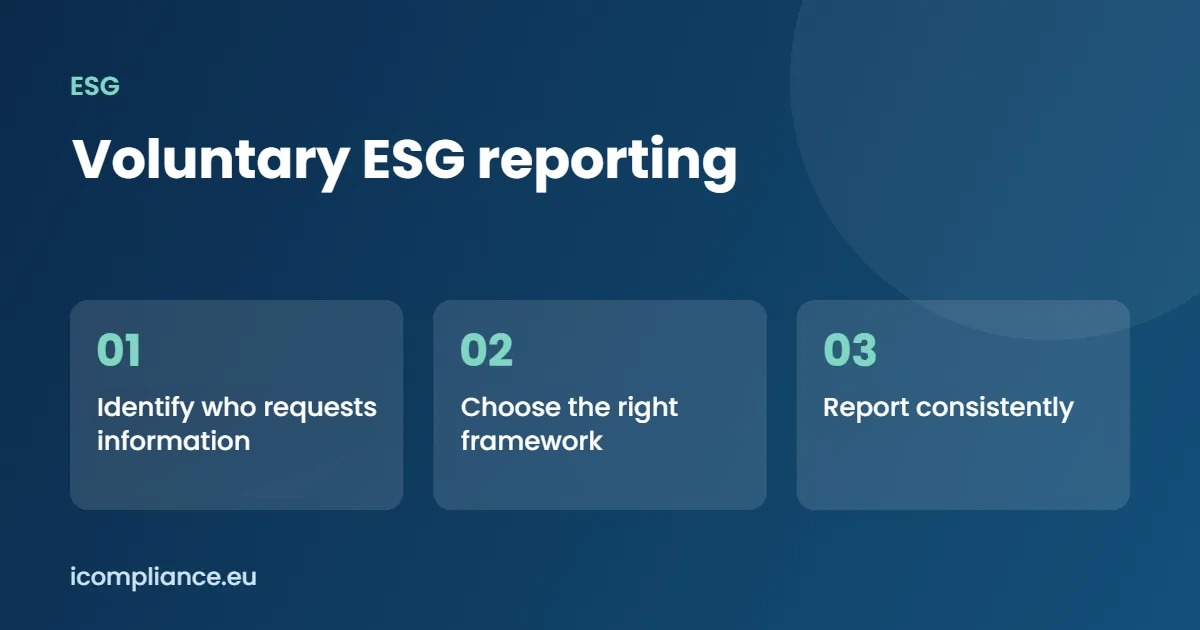
It starts by mapping who asks for information and which topics interest them, followed by choosing the most suitable framework, such as VSME for SMEs or the GRI standards. Indicators, data sources and frequency are then defined, and a base version is prepared that can be adapted to each recipient.
Trust comes from traceable data, indicators that are comparable from one year to the next and language without exaggeration. It is advisable to state the scope, the calculation criteria and the limitations, and to avoid environmental claims that cannot be demonstrated with evidence.
The most widely used frameworks include the Global Reporting Initiative standards and the EFRAG VSME standard, which offer recognised structures for voluntary reporting.
Does voluntary reporting mean less rigour? No. The absence of a legal obligation does not remove the need for rigour. Customers and banks compare answers, and data without a source or exaggerated claims damage credibility. It is advisable to apply the same traceability criteria used for financial information.
Which format should we use? A base report, with the essential indicators, can be complemented by annexes specific to each recipient. This way, the organisation keeps a single version of the data and adapts only the presentation.
iCompliance helps organisations structure voluntary ESG reporting, from choosing the framework and defining the indicators to preparing a base report adaptable to customers, banks and investors. To understand where to start, talk to our team and receive a proposal tailored to the size and sector of your organisation.
Voluntary and stakeholder reporting covers all sustainability information that an organisation chooses or is asked to provide, even when no law requires a formal report. Customers, banks, investors, public buyers, employees and local communities increasingly expect clear information about environmental and social performance and about governance practices. Companies outside the direct scope of the CSRD are often affected indirectly, because larger partners need their data.
Doing this well brings practical benefits: easier access to financing, stronger positions in tenders, better relations with customers and a more structured view of the business. Doing it badly leads to duplicated work, inconsistent answers and credibility risks.
There is no single format for voluntary reporting, so the first step is to choose a framework that suits your audience. The VSME standard is a good option for SMEs that need a common language to respond to value-chain requests. Other organisations prefer to use selected ESRS data points as a reference, or the structure of widely used voluntary standards. We help you decide based on who will read the report, what they need to know and how much effort is proportionate.
Whichever framework is chosen, the principles are similar. The report should be relevant, meaning it covers topics that matter to stakeholders. It should be accurate, supported by data and evidence. It should be comparable, using stable definitions from year to year. And it should be balanced, showing both achievements and areas still to be improved.
Stakeholder dialogue is part of the process. We help identify who the main stakeholders are, what they ask for, and how to collect their views, through short surveys, meetings or the analysis of requests already received. The results feed a simple materiality assessment that guides which topics deserve detailed disclosure.
We then organise the information into a report and, if useful, a shorter summary for customers, banks or the website. Responsibilities for data, review and approval are written down, which gives continuity even if team members change.
Many companies that start with voluntary reporting later move into mandatory regimes, through growth, group structure or changes in regulation. Building a clear process now reduces the cost of that transition, because data collection, controls and governance can be expanded rather than rebuilt.
If you are unsure what to report, to whom and in which format, we can start with a short review of your stakeholders’ requests and propose a practical reporting plan for the next cycle.
A short, clear report is usually better than a long one. Readers want to find the key facts quickly: what you do, how you measure it, what has improved and what comes next. We help you keep the document focused, consistent and easy to update every year.
ESG Reporting: CSRD, ESRS e VSME
Reporting tailored to clients, investors, banks, tenders, supply chains or internal governance requirements.