
ESG & Sustainability
Support for the selection, design and implementation of tools to collect, validate, monitor and report ESG data.

Scattered spreadsheets and data without clear ownership increase the risk of error. Technology should simplify data collection, validation and reporting.

The company is provided with objective criteria to help it decide between a tool, a template or an integration.

Technology comes after the process: first governance, then data, then tools.
A 30-minute conversation to assess priorities and draw up a practical plan — together.
ESG
ESG technology and data are the infrastructure that allows sustainability indicators to be collected, validated and reported with traceability. Without it, reporting depends on scattered spreadsheets, manual collection and figures that are hard to justify in an assurance engagement.
An inventory of data sources and owners, a central repository with consistent definitions, validation rules and version control, a change log and outputs prepared for reports and dashboards. The size of the solution should be proportionate to the organisation.
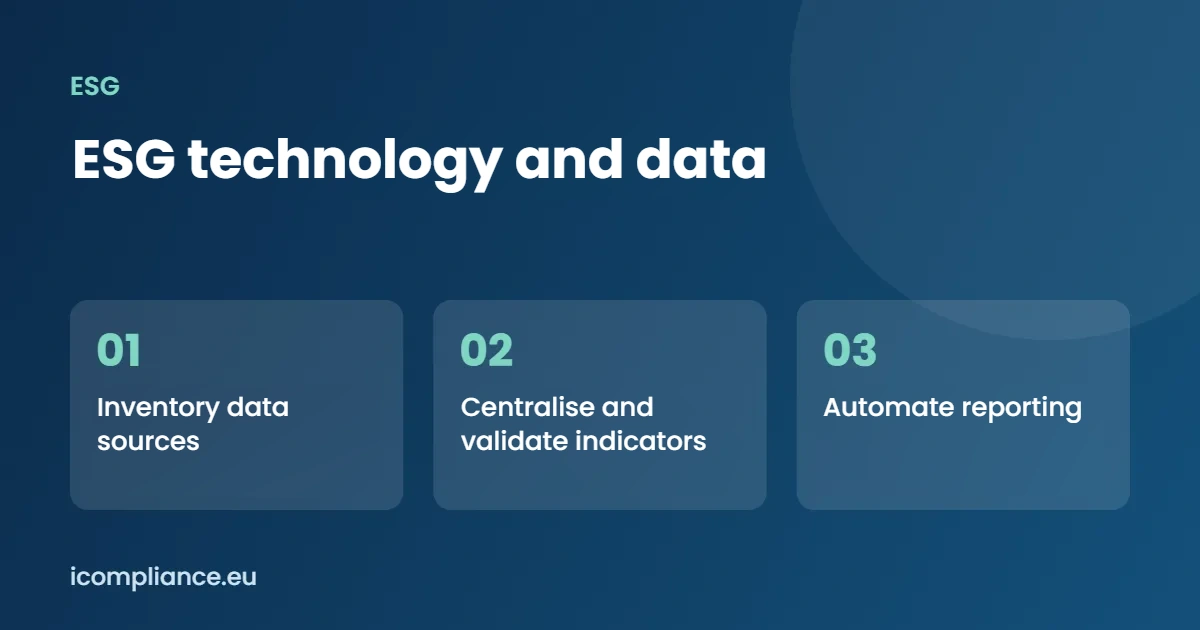
Many organisations start with well-controlled spreadsheets and move to platforms as volume and requirements grow. The criterion is not the tool, but the ability to show where each number comes from, who validated it and when it was changed.
The traceability requirements stem from the ESRS, published by EFRAG, and from the framework described by the European Commission on sustainability reporting.
Do I need a platform to report on ESG? Not always. For organisations with few indicators, well-controlled spreadsheets with named owners and a change log may be enough. As data volumes and assurance requirements grow, it is worth assessing a dedicated platform.
What does an auditor value? Traceability: knowing where each number comes from, who validated it, which formula was used and when it was changed. A clear record of these elements reduces the time and cost of assurance.
iCompliance helps organisations define and implement the technology and data foundation for ESG, from the inventory of sources and the indicator model to the automation of data collection. The work includes documenting the controls for assurance. To find out where to start, talk to our team and receive a proposal tailored to the size and sector of your organisation.
Good ESG data technology starts with a simple question: which decisions and disclosures will depend on this data? Before comparing tools, we map the indicators you have to report, the systems where the information already exists and the people who maintain it. In most organisations, energy invoices sit in finance, employee data in human resources, supplier information in purchasing and safety records in operations. ESG data technology is the layer that connects these sources, so that each value is collected once, validated and reused.
For many small and medium-sized companies, a well-structured spreadsheet model, with clear owners, locked formulas and a documented method, is enough in the first reporting cycles. For larger groups, or where there are several entities and sites, a dedicated platform can reduce manual work, keep a complete audit trail and make year-on-year comparisons easier. We help you decide which option is proportionate, so that you do not buy software before the process is defined.
Whatever the tool, a reliable process has the same basic elements. First, a data dictionary: for each indicator, the definition, unit, calculation method, source, frequency and owner. Second, collection rules, so that every site and department reports in the same format and on the same calendar. Third, validation checks, such as range tests, comparisons with the previous period and reconciliation with invoices or accounting records. Fourth, a log of changes and approvals, so that whoever reviews the report can see who changed what and why.
These controls matter because sustainability information is increasingly scrutinised by banks, customers and auditors. Under the CSRD and the ESRS, reported data may be subject to assurance and, under the VSME standard, customers expect clear and consistent figures. A traceable process makes that review much easier to follow.
We also look at how the solution fits into your IT environment: access rights, data protection, backups and the ability to export data in open formats. Good governance means that ESG data has a named owner, that responsibilities are written down and that the board or management receives a short summary on a regular basis.
If you want to know whether your current ESG data set-up is ready for the next reporting cycle, a short diagnostic is usually the best first step. It identifies gaps, quick wins and the level of technology that makes sense for your size and obligations.
Every organisation starts from a different point. If you already have data in spreadsheets, accounting software or an HR system, we can review it, show how it maps to the indicators you need and recommend the smallest set of changes that makes your next report reliable.

Let’s assess your priorities and draw up a practical plan — together.