
ESG & Sustainability
Definition of ESG goals, priorities, responsibilities, and an implementation plan aligned with the business strategy.

ESG without a strategy becomes a series of isolated tasks. This service defines objectives, priorities, and ownership to integrate sustainability into management.

The company ends up with a workable plan, not just a conceptual document.

The ESG strategy should support growth, customer access, financing, reputation, and resilience.
A 30-minute conversation to assess priorities and draw up a practical plan — together.
ESG
The ESG roadmap is the plan that translates the sustainability strategy into concrete actions, deadlines, owners and resources. It allows management to know what to do first, what depends on what and how to measure progress.
It starts from materiality and reporting obligations, objectives and targets are defined, the necessary initiatives are listed, ranked by impact, effort and legal obligation, and budget and an owner are assigned. The result is a three-to-five-year plan with annual milestones.
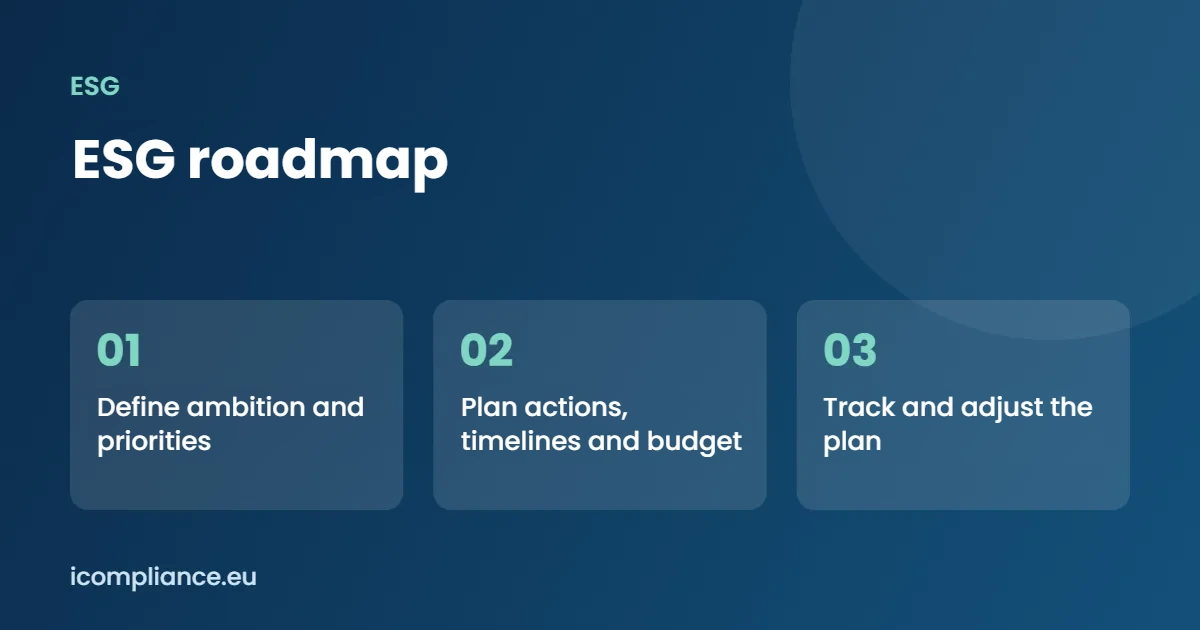
The roadmap should be reviewed at least once a year, adjusted to regulatory changes and integrated into the organisation’s planning and budget. Progress indicators should feed the management dashboard and sustainability reporting.
The obligations that shape the deadlines are described on the European Commission’s sustainability reporting page and in the CSRD Directive on EUR-Lex, and the EFRAG standards help define the data needed.
How long should a roadmap cover? Usually three to five years, with annual milestones. Shorter horizons do not allow relevant investments to be planned, and longer horizons become hard to maintain in the face of regulatory change.
How can the actions be funded? By building them into the annual budget and distinguishing mandatory actions, those that reduce costs and those that build positioning. This classification helps justify priorities to the board.
iCompliance helps organisations build the ESG roadmap, prioritising initiatives, deadlines, budget and owners, and integrating it into the organisation’s planning and reporting. To find out where to start, talk to our team and receive a proposal tailored to the size and sector of your organisation.
An ESG strategy roadmap translates ambition into a plan with priorities, owners, resources and dates. Many organisations have good intentions and scattered initiatives, but no clear sequence. A roadmap solves this by showing what will be done first, what depends on what and how progress will be measured.
We begin with a short diagnostic: your sector, size, customers, financing, regulatory exposure and current practices. This is combined with a materiality assessment, using the principle of double materiality where relevant, to identify which environmental, social and governance topics have the greatest impact on your business and on the outside world. The result is a focused list of priorities instead of a long generic agenda.
A practical roadmap usually covers four elements. The first is vision and scope: what the organisation wants to achieve in sustainability and over what period. The second is the set of objectives and targets, linked to measurable indicators. The third is the action plan, with responsible persons, budget, milestones and dependencies. The fourth is governance: who monitors progress, how often and how decisions are escalated.
Regulation is part of the context. Depending on your situation, the plan may need to prepare for CSRD and ESRS reporting, respond to value-chain requests using the VSME standard or meet requirements from banks and public buyers. We place these obligations on the timeline so that reporting readiness develops in parallel with operational improvements, not at the last minute.
A roadmap is only useful if it respects capacity. We therefore distinguish between quick wins, such as policies, data collection routines and clearer responsibilities, and longer projects such as decarbonisation measures or supply chain programmes. Each action is described in simple terms, with the expected benefit and effort.
We also recommend integrating the roadmap with enterprise risk management. Climate, social and governance risks can be assessed with the same methods used for other business risks, following ISO 31000, so that sustainability actions compete fairly for resources with other priorities.
Finally, the roadmap should be reviewed at least once a year. Targets may need adjustment, new regulations may appear and early results will show what works. A short annual review keeps the plan alive and credible, and gives the board a clear view of progress.
The first deliverable is usually short: a one-page roadmap with priorities, owners and dates, supported by a more detailed action list. This format is easy to present to management, to share with banks or customers and to update as results and requirements change.

Let’s assess your priorities and draw up a practical plan — together.