
ESG & Sustainability
Definition of KPIs, data sources, responsible parties, reporting frequency and dashboards for monitoring ESG performance.

Without consistent data, ESG cannot be managed. Monitoring ensures discipline, comparability and early warning.

Teams will now monitor progress and deviations based on reliable information.

The indicators must be proportionate to the company and aligned with material issues.
A 30-minute conversation to assess priorities and draw up a practical plan — together.
ESG
ESG KPIs are the indicators an organisation uses to track its environmental, social and governance performance. They are useful when they are linked to material topics, have clear targets and feed decisions, and not just the annual report.
It starts with the materiality analysis and reporting obligations; measurable indicators are selected for each topic, the calculation method, data source and frequency are defined, and owners are assigned. Common examples are energy intensity, emissions, staff turnover and workplace accidents.
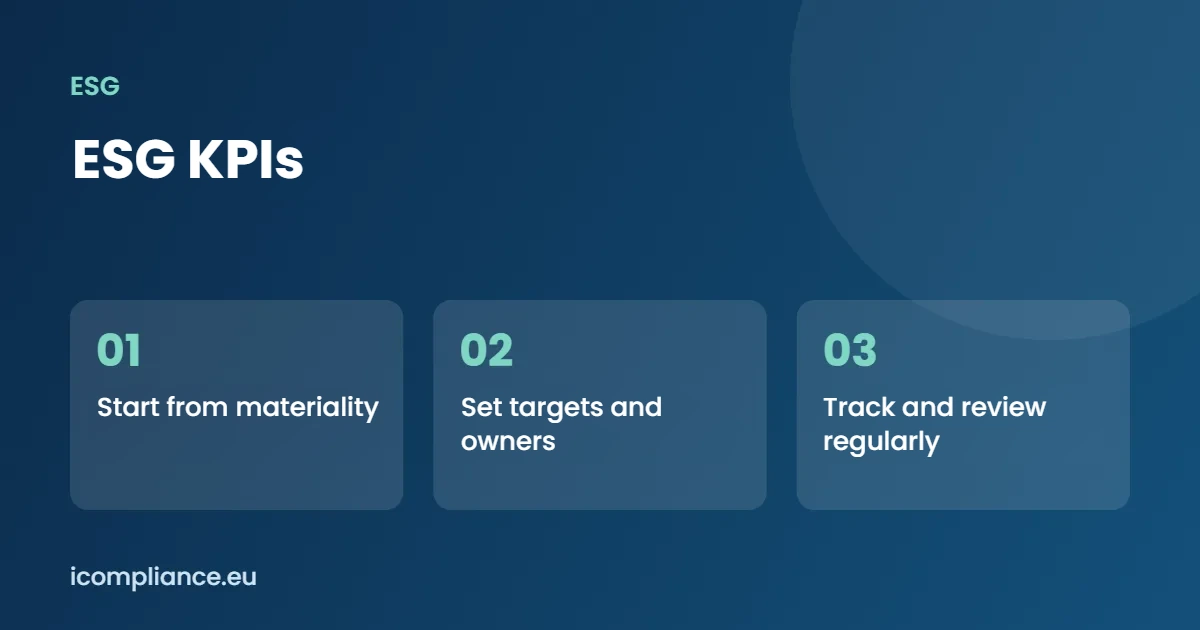
Each indicator should have a target, an acceptable deviation and an associated action when the result departs from what is expected. A quarterly review with management and the inclusion of ESG indicators in performance dashboards bring sustainability closer to day-to-day management.
The ESRS published by EFRAG and the GRI standards offer catalogues of recognised indicators, and the VSME proposes a proportionate set for SMEs.
How many ESG KPIs are enough? As many as are needed to track the material topics and meet the reporting obligations, usually between ten and twenty for an SME. More indicators increase the collection effort and dilute management’s attention.
How often should we measure? It depends on the indicator: energy consumption can be monthly, social indicators quarterly and some, such as supplier assessment, annual. What matters is that the frequency allows action before the year-end close.
iCompliance helps organisations define ESG KPIs, linked to materiality, targets, calculation methods and owners, and integrate them into management dashboards and reporting. To find out where to start, talk to our team and receive a proposal tailored to the size and sector of your organisation.
Monitoring ESG KPIs is not about collecting as many indicators as possible. It is about choosing a small number of measures that show whether sustainability objectives are being met and that management can act on. We start from your strategy, material topics and reporting obligations, and from there define the indicators that matter for each area: environment, social and governance.
A useful KPI has a clear definition, a unit, a data source, an owner, a target and a reporting frequency. Without these elements, figures cannot be compared over time and discussions turn into debates about methodology instead of decisions. We document each indicator in a simple data sheet so the whole team uses the same meaning.
Typical environmental indicators include energy consumption, greenhouse gas emissions by scope, water use and waste by type and destination. On the social side, organisations often track workforce composition, training hours, health and safety incidents, absenteeism and pay-related measures. For governance, common indicators cover policies in place, ethics and whistleblowing cases, supplier assessments and the status of internal controls.
The right selection depends on the framework applied. Companies in scope of the CSRD follow the ESRS data points that result from their double materiality assessment. SMEs using the VSME standard work with a more limited set of disclosures. Customers, banks and investors may add their own requirements, and we help you consolidate them into a single, manageable set.
Monitoring only creates value when results reach decision makers. We design simple dashboards and periodic reviews, usually quarterly, that show current values, trend, target and the actions underway. Thresholds and alerts highlight where intervention is needed, and owners explain deviations briefly instead of producing long reports.
We also connect KPIs with risk management. If an indicator moves outside its expected range, the issue can be assessed using the same logic applied to other business risks, in line with ISO 31000, and a treatment plan can be agreed. This avoids treating sustainability as a separate topic and makes it part of normal management.
Finally, we recommend an annual review of the KPI set, to remove indicators that are no longer useful, add new ones required by regulation or stakeholders and confirm that data quality is adequate. If you are starting from scratch, we can propose a first set of indicators and a calendar that fits your resources.
If you already track some indicators, we do not start again. We review what exists, check definitions and data quality, and keep what works. The aim is a KPI set your team understands, maintains with little effort and can explain clearly to managers, customers and banks.

Let’s assess your priorities and draw up a practical plan — together.