
Risk Assessment and Risk Matrices
We design probability and impact matrices tailored to the organisation’s actual context, with explicit criteria for each level, rather than generic scales from 1 to 5.
We design probability and impact matrices tailored to the organisation’s actual context — not generic 1 to 5 scales — with explicit criteria for each level, so that the classification of a risk remains consistent across assessors and over time.
Risk management only creates value when it supports decision-making, prioritisation and accountability.
The deliverables are designed for practical use, not just for filing.
A 30-minute conversation to assess priorities and draw up a practical plan — together.
Risk management
A risk matrix crosses the likelihood of an event with its impact and places each risk in a priority zone, usually green, yellow or red. It is one of the most widely used tools for communicating risks to management because it can be read at a glance.
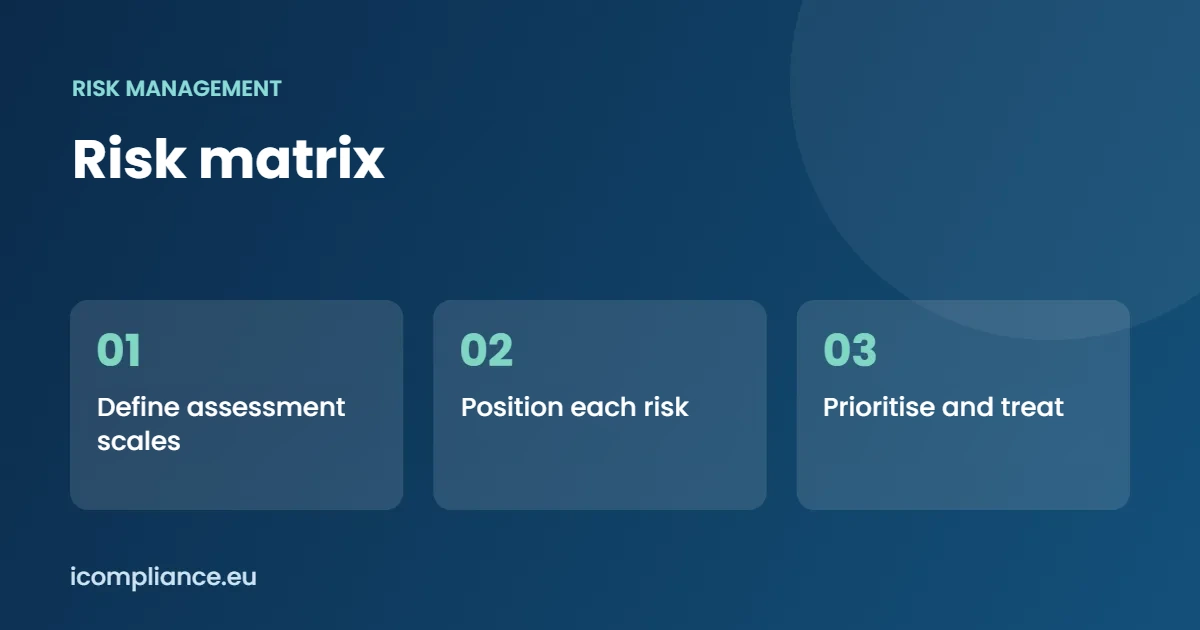
The first step is to define clear scales, with objective criteria for each level, for example financial, regulatory and reputational impact. Each risk is then positioned before and after controls, what each zone requires in terms of decision and deadline is defined, and the matrix is updated whenever the context changes.
The matrix simplifies, and that simplification has limits: risks with equal scores can be of very different natures, and poorly calibrated scales give a false sense of rigour. It is advisable to complement the matrix with risk descriptions, scenario analysis and monitoring indicators.
The IEC 31010 standard on risk assessment techniques covers the consequence and likelihood matrix and explains its advantages and limitations, in line with the ISO 31000 process.
iCompliance helps organisations build a risk matrix tailored to the business, with calibrated scales, criteria by type of impact and decision rules by zone. We deliver the matrix, the associated register and training for the teams that will maintain it. To understand where to start, talk to our team and receive a proposal tailored to the size and sector of your organisation.
A risk assessment answers three questions: what could go wrong, how likely is it and what would be the impact. Our method follows the principles of ISO 31000 and is adapted to the size and complexity of your organisation. It has four steps: identify the risks, analyse them, evaluate them against agreed criteria and define treatment.
During identification, we involve the people closest to operations, finance, compliance and technology, since they usually know the real weak points. Risks are described clearly, with cause, event and consequence, and are recorded in a register with an owner. During analysis, we assign likelihood and impact using scales defined for your business, which can be qualitative, semi-quantitative or quantitative depending on the available data.
A risk matrix places each risk according to its likelihood and impact, giving a quick visual picture of priorities. To be useful, the matrix must reflect your reality: impact levels should refer to your financial thresholds, operational limits and reputational concerns, not to generic examples. We also define what each colour means in terms of action, such as accept, monitor, treat or escalate to the board.
Matrices have limits. They simplify, and they may hide interdependencies between risks or underestimate rare but severe events. We therefore complement them with comments, scenarios and, where relevant, stress tests, so decisions are not based on colours alone.
The assessment ends with a treatment plan: for each priority risk, the actions to reduce likelihood or impact, the person responsible, the deadline and the indicator that shows progress. Risks are reviewed regularly, usually every quarter, and whenever there is a significant change in the business or the environment.
Results can feed board reporting, internal audit, insurance discussions and sustainability disclosures, avoiding duplicated effort. If you want a first risk assessment or a review of your current matrix, we can help design a proportionate approach and train your team to maintain it.
Frequently Asked Questions
Because 1–5 scales without explicit criteria lead to subjective and inconsistent ratings among assessors — the value of the matrix lies in the documented criteria behind each level, not in the scale itself.
The process combines interviews, analysis of existing data and benchmarking, followed by an action plan with clearly defined responsibilities and deadlines.
We typically involve senior management, operational teams and, where applicable, internal audit in a phased process that is tailored to the organisation’s availability.
Let’s assess your priorities and draw up a practical plan — together.