
Risk Reporting for Management
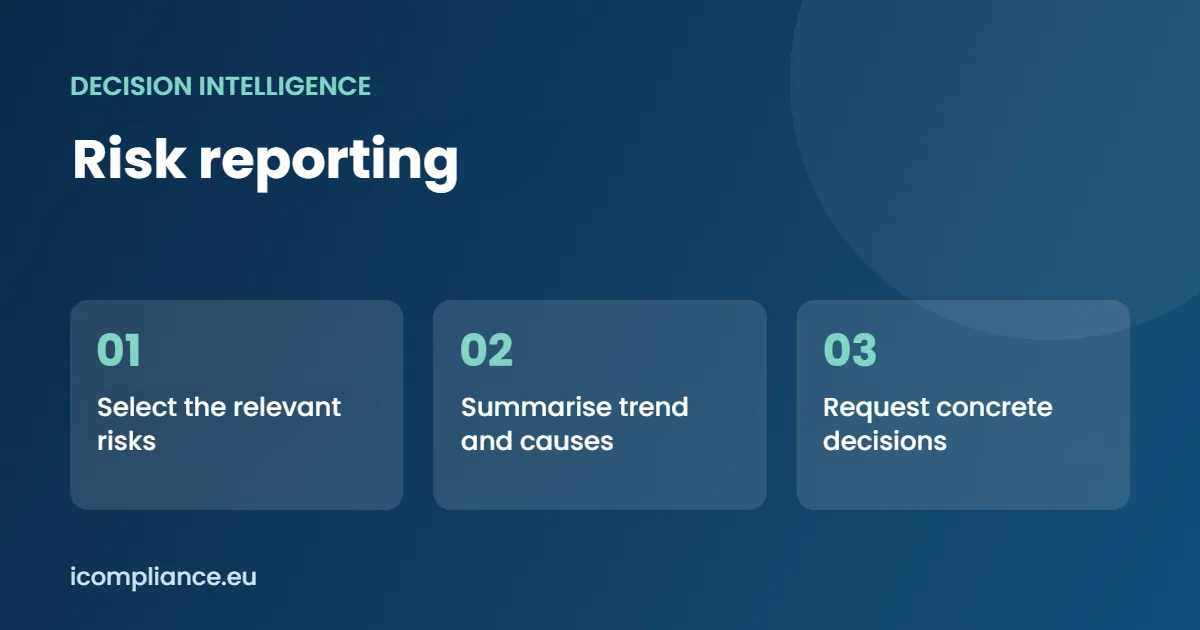
We produce risk reports for management that focus on matters requiring a decision — risks outside the defined risk appetite, KRI trends and overdue actions — in a 2- to 3-page document.
We design risk reports for management and executive committees that focus on what requires a decision — risks outside the defined risk appetite, trends in KRI indicators and overdue actions — rather than exhaustive lists of risks that dilute the relevant message, all in a single 2- to 3-page document.
Risk management only creates value when it supports decision-making, prioritisation and accountability.
The deliverables are designed for practical use, not just for filing.
A 30-minute conversation to assess priorities and draw up a practical plan — together.
Decision Intelligence
Risk reporting turns the risk register and indicators into information that the board can use. A good report does not list everything that exists, but shows what has changed, what requires a decision and what could compromise the objectives.
A summary page with the main risks and their evolution, the status of treatment plans, the indicators that have exceeded thresholds and the relevant events of the period. Each point states the owner, the deadline and the decision or support requested from the board.
The frequency should follow the rhythm of the business, normally monthly for management and quarterly for the board, with extraordinary alerts for serious events. Quality depends on consistent data, common definitions and a single version of the information, avoiding parallel reports that contradict each other.
Communication and reporting are part of the ISO 31000 process, and COSO ERM highlights the importance of risk information integrated with performance and strategy.
iCompliance helps organisations design risk reports for management and the board, with a short format, consistent indicators and decisions requested. The work includes the report template, the reporting calendar and the automation of data collection. To understand where to start, talk to our team and receive a proposal tailored to the size and sector of your organisation.
Good board risk reporting answers a few questions quickly: what are the main risks today, how have they changed since the last meeting, what is being done about them and who is responsible. Many boards receive long registers with hundreds of lines; few receive a clear, decision-ready view.
We design reports around a short list of priority risks, each with a rating based on likelihood and impact, a trend, the status of treatment actions and an owner. Indicators and thresholds are agreed in advance, so that the board knows when an issue needs escalation. Following the principles of ISO 31000, risk information is treated as an input to strategy and performance, not as a separate compliance exercise.
A typical pack also includes emerging topics, such as regulatory changes or sustainability matters, and a short section on actions requested from the board. This keeps meetings focused on decisions instead of explanations.
Implementation is gradual. We start with the information you already have, build a first version of the report, test it with management and refine the format after one or two cycles. Over time the same data can also support ESG disclosures, bank discussions and internal audit, which reduces duplicated work.
If your board needs clearer risk information, we can review current reports and propose a format adapted to your size, sector and governance model.
Frequently Asked Questions
It should clearly set out what falls outside the defined risk appetite, the trends in key indicators and the actions currently underway — in 2 to 3 pages, not an exhaustive table requiring further interpretation.
We follow a structured process — assessment, design, implementation and monitoring — tailored to the organisation’s maturity and size, with practical deliverables at each stage.
Most projects begin with a 2- to 4-week assessment, followed by phased implementation over several months, involving senior management and the relevant departments.
Let’s assess your priorities and draw up a practical plan — together.